
The police shut down the Christians and let the drug dealer stay

By Ben Schettler, The Center for Truth in Love
I want to ask you a simple question before I tell you this story.
If you were a police officer at a public park and you saw two groups of people, one group having peaceful conversations about faith and civic life at a table, and another person openly selling drugs at a table 25 feet away, which group would you approach?
Take a moment. Think about it.
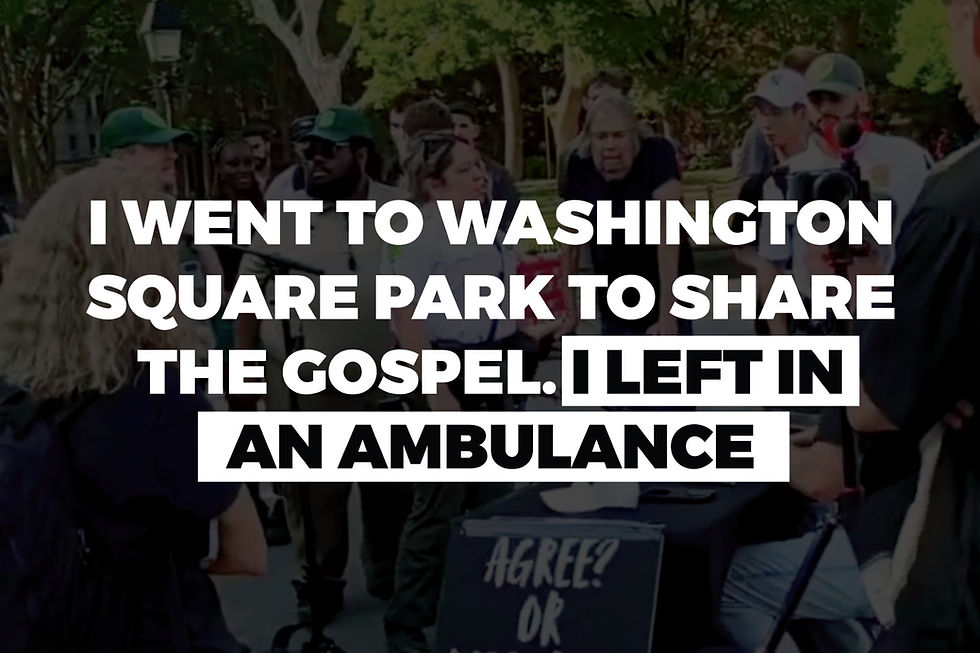
Now let me tell you what happened to us while at Washington Square Park in New York City. Because the answer to that question, as it played out in real life in front of me, is the reason I ended up in an ambulance…and the reason every American, regardless of their faith or politics, should be paying attention.
What Happened?
Our team arrived at Washington Square Park to do what we have done many times: engage people in open, honest conversations about faith, meaning, and the Gospel of Jesus Christ. We set up a table. We opened our Bibles. We were ready to talk to anyone who wanted to engage.
Twenty-five feet away, a man was sitting at a table selling drugs. Openly. He was conducting illegal commerce in a public park in broad daylight.
New York City Park Police arrived.
They walked past the drug dealer.
They came to us.
They told us our conversations needed to stop.
They walked past the drug dealer. They came to us. They told us our conversations needed to stop. No law was cited. No ordinance was read. No permit requirement was explained.
No law was cited. No ordinance was read. No permit requirement was explained. Just: “Stop. Leave. You cannot do this here.”
We left. But I needed to understand what had just happened. Because what I had witnessed did not feel like a misunderstanding. It felt like a system making a choice about whose presence was acceptable and whose was not.
So, I met with an attorney.
What the law actually says
Here is the legal framework, simplified, but accurate. This is not opinion. This is constitutional law that has been established through decades of court decisions.
Traditional Public Forums
Public parks, streets, and sidewalks are classified under First Amendment law as "traditional public forums" — spaces that have historically been open for public assembly, debate, and speech. Washington Square Park is one of the most prominent traditional public forums in the United States. In these spaces, the government faces its highest burden when restricting speech.
Content-Neutral vs. Content-Based Restrictions
The government CAN impose reasonable restrictions on the time, place, and manner of speech in public forums, but those restrictions must be content-neutral (applying equally to everyone, regardless of what they are saying) and narrowly tailored to serve a significant government interest. What the government CANNOT do is restrict speech because of its content or viewpoint. That is called viewpoint discrimination, and it is one of the most clearly prohibited acts under the First Amendment.
What Viewpoint Discrimination Looks Like
Viewpoint discrimination occurs when the government allows one perspective on a topic while silencing another. It does not require a written policy or a formal statement of intent. It can occur through selective enforcement — allowing one group to speak while silencing another in the same space, under the same conditions, with no content-neutral justification.
The Drug Dealer Standard
Here is where this case becomes legally striking. At the moment our team was ordered to stop speaking, an individual was openly engaged in illegal activity — drug sales — at a nearby table, with no police intervention whatsoever. The standard being applied in that park, in that moment, was: illegal drug commerce = acceptable. Christian conversation = unacceptable. That is not a time, place, and manner restriction. That is viewpoint discrimination.
The standard being applied in that park was this: illegal drug commerce — acceptable. Christian conversation — unacceptable. That is not a permit issue. That is a First Amendment violation.
My attorney was unambiguous: we had every legal right to be in that park. We had every legal right to continue our conversations. The police order had no lawful basis. We could go back.
So we did.
What happened when we followed legal advice
On Wednesday, our team returned to Washington Square Park on the legal advice of counsel. This matters. We did not go back out of stubbornness or provocation. We went back because a licensed attorney reviewed our situation and confirmed our First Amendment right to be there. We followed the law. We exercised a confirmed constitutional right.
Within minutes of entering the park, I was surrounded by a mob. I was sucker-punched from behind. My phone was stolen. And beaten by multiple attackers. They called me a Nazi. They said they wanted me to die.
I was taken by ambulance to the emergency room and diagnosed with a concussion, on top of a pre-existing traumatic brain injury that makes any head trauma medically serious. I am still in treatment.
Let that sequence sink in. We were silenced by police for exercising a constitutionally protected right. We confirmed that right with an attorney. We returned to exercise it. We were then beaten by a mob. And the implicit message at the scene, from the atmosphere, from the response, was that this was our fault for coming back.
We were silenced for exercising a right. We confirmed the right with an attorney. We came back to exercise it. We were beaten by a mob. And somehow, we were the problem.
This is what the erosion of free speech actually looks like. It does not always arrive with a government memo. Sometimes it arrives with a badge and a quiet order. And when that fails, it arrives with fists.
Why this Matters Beyond Me
I want to be clear: this is not primarily a story about me. It is a story about a pattern that anyone who values free expression should recognize, regardless of whether they share my faith.
The principle being violated here is not a Christian principle. It is an American one. The First Amendment does not protect speech because it is popular. It protects speech precisely because it might be unpopular. The whole point of free expression is that the government does not get to decide which ideas are welcome in the public square.
Ask yourself honestly: who is it next?
The First Amendment does not protect speech because it is popular. It protects speech precisely because it might not be. The moment government chooses which viewpoints are welcome, the speech silenced first will always be the speech someone finds inconvenient.
What should have happened?
A police officer in a public park has clear obligations. Here is what should have happened:
The officer should have addressed the illegal drug commerce first or, at minimum, simultaneously with any other enforceable action.
If a permit issue existed for our table, it should have been applied equally to every table in the park, including the one being used for drug sales.
Any order to cease First Amendment-protected activity in a traditional public forum requires legal justification. A specific ordinance, a specific violation, a content-neutral reason...none was provided.
When our team returned the following day on legal advice, officers should have been present to ensure that lawful expressive activity could occur without physical threat.
What needs to happen now:
A formal review of the Park Police conduct on Tuesday, specifically the decision to approach our group while leaving drug activity unaddressed.
An investigation into whether Wednesday's attack meets the threshold for a bias-motivated crime under New York state law. Attackers made explicit statements targeting religious identity.
I am not calling for vengeance. I am calling for consistency. Enforce the law equally or do not enforce it at all. That is not a radical position. It is the foundation of equal protection under the law.
A Final Word to the Politically Engaged
Whether you are conservative or progressive, religious or secular, you should be troubled by what happened. The right to speak freely in a public space, to hold a table, to engage strangers in conversation, to say what you believe without fear of government suppression or mob violence is not a partisan value. It is the foundational value from which every other political debate is made possible.
You cannot have a functioning democracy when the government selectively silences disfavored viewpoints. You cannot have a free society when the cost of exercising a constitutional right is a trip to the emergency room.
This story is spreading because people across the political spectrum know something went wrong. Share it. Talk about it. Demand better from the institutions that are supposed to protect these rights for all of us.
The park is public. The speech is protected. The law is clear.
— Ben Schettler
Co-Founder & President, The Center for Truth in Love

Comments